some two nights ago i accompanied a relative of mine who is afflicted with epilepsy to some ceremony of sorts.
the sweetest thing ever.
that is all.
some two nights ago i accompanied a relative of mine who is afflicted with epilepsy to some ceremony of sorts.
the sweetest thing ever.
that is all.
At about the age of fifty, Tolstoy relates that he began to have moments of perplexity, of what he calls arrest, as if he knew not “how to live,” or what to do. It is obvious that these were moments in which the excitement and interest which our functions naturally bring had ceased. Life had been enchanting, it was now flat sober, more than sober, dead. Things were meaningless whose meaning had always been self-evident. The questions “Why?” and “What next?” began to beset him more and more frequently. At first it seemed as if such questions must be answerable, and as if he could easily find the answers if he would take the time; but as they ever became more urgent, he perceived that it was like those first discomforts of a sick man, to which he pays but little attention till they run into one continuous suffering, and then he realizes that what he took for a passing disorder means the most momentous thing in the world for him, means his death.
These questions “Why?” “Wherefore?” “What for?” found no response.
“I felt,” says Tolstoy, “that something had broken within me on which my life had always rested, that I had nothing left to hold on to, and that morally my life had stopped. An invincible force impelled me to get rid of my existence, in one way or another. It cannot be said exactly that I WISHED to kill myself, for the force which drew me away from life was fuller, more powerful, more general than any mere desire. It was a force like my old aspiration to live, only it impelled me in the opposite direction. It was an aspiration of my whole being to get out of life.
“Behold me then, a man happy and in good health, hiding the rope in order not to hang myself to the rafters of the room where every night I went to sleep alone; behold me no longer going shooting, lest I should yield to the too easy temptation of putting an end to myself with my gun.
“I did not know what I wanted. I was afraid of life; I was driven to leave it; and in spite of that I still hoped something from it.
“All this took place at a time when so far as all my outer circumstances went, I ought to have been completely happy. I had a good wife who loved me and whom I loved; good children and a large property which was increasing with no pains taken on my part. I was more respected by my kinsfolk and acquaintance than I had ever been; I was loaded with praise by strangers; and without exaggeration I could believe my name already famous. Moreover I was neither insane nor ill. On the contrary, I possessed a physical and mental strength which I have rarely met in persons of my age. I could mow as well as the peasants, I could work with my brain eight hours uninterruptedly and feel no bad effects.
“And yet I could give no reasonable meaning to any actions of my life. And I was surprised that I had not understood this from the very beginning. My state of mind was as if some wicked and stupid jest was being played upon me by some one. One can live only so long as one is intoxicated, drunk with life; but when one grows sober one cannot fail to see that it is all a stupid cheat.
What is truest about it is that there is nothing even funny or silly in it; it is cruel and stupid, purely and simply.
“The oriental fable of the traveler surprised in the desert by a wild beast is very old.
“Seeking to save himself from the fierce animal, the traveler jumps into a well with no water in it; but at the bottom of this well he sees a dragon waiting with open mouth to devour him. And the unhappy man, not daring to go out lest he should be the prey of the beast, not daring to jump to the bottom lest he should be devoured by the dragon, clings to the branches of a wild bush which grows out of one of the cracks of the well. His hands weaken, and he feels that he must soon give way to certain fate; but still he clings, and see two mice, one white, the other black, evenly moving round the bush to which he hangs, and gnawing off its roots
“The traveler sees this and knows that he must inevitably perish; but while thus hanging he looks about him and finds on the leaves of the bush some drops of honey. These he reaches with his tongue and licks them off with rapture.
“Thus I hang upon the boughs of life, knowing that the inevitable dragon of death is waiting ready to tear me, and I cannot comprehend why I am thus made a martyr. I try to suck the honey which formerly consoled me; but the honey pleases me no longer, and day and night the white mouse and the black mouse gnaw the branch to which I cling. I can see but one thing: the inevitable dragon and the mice–I cannot turn my gaze away from them.
“This is no fable, but the literal incontestable truth which every one may understand. What will be the outcome of what I do to-day? Of what I shall do to-morrow? What will be the outcome of all my life? Why should I live? Why should I do anything? Is there in life any purpose which the inevitable death which awaits me does not undo and destroy?
“These questions are the simplest in the world. From the stupid child to the wisest old man, they are in the soul of every human being. Without an answer to them, it is impossible, as I experienced, for life to go on.
“‘But perhaps,’ I often said to myself, ‘there may be something I have failed to notice or to comprehend. It is not possible that this condition of despair should be natural to mankind.’ And I sought for an explanation in all the branches of knowledge acquired by men. I questioned painfully and protractedly and with no idle curiosity. I sought, not with indolence, but laboriously and obstinately for days and nights together. I sought like a man who is lost and seeks to save himself–and I found nothing. I became convinced, moreover, that all those who before me had sought for an answer in the sciences have also found nothing. And not only this, but that they have recognized that the very thing which was leading me to despair–the meaningless absurdity of life–is the only incontestable knowledge accessible to man.”
To prove this point, Tolstoy quotes the Buddha, Solomon, and Schopenhauer. And he finds only four ways in which men of his own class and society are accustomed to meet the situation. Either mere animal blindness, sucking the honey without seeing the dragon or the mice–“and from such a way,” he says, “I can learn nothing, after what I now know;” or reflective epicureanism, snatching what it can while the day lasts–which is only a more deliberate sort of stupefaction than the first; or manly suicide; or seeing the mice and dragon and yet weakly and plaintively clinging to the bush of life. Suicide was naturally the consistent course dictated by the logical intellect.
“Yet,” says Tolstoy, “whilst my intellect was working, something else in me was working too, and kept me from the deed–a consciousness of life, as I may call it, which was like a force that obliged my mind to fix itself in another direction and draw me out of my situation of despair. . . . During the whole course of this year, when I almost unceasingly kept asking myself how to end the business, whether by the rope or by the bullet, during all that time, alongside of all those movements of my ideas and observations, my heart kept languishing with another pining emotion. I can call this by no other name than that of a thirst for God. This craving for God had nothing to do with the movement of my ideas–in fact, it was the direct contrary of that movement–but it came from my heart. It was like a feeling of dread that made me seem like an orphan and isolated in the midst of all these things that were so foreign. And this feeling of dread was mitigated by the hope of finding the assistance of someone.
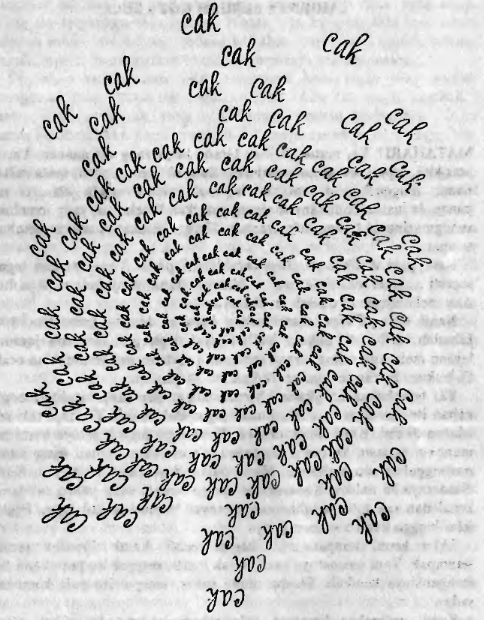
this circle, over here, is an inscription (or drawing, if you like) from Danarto, an Indonesian writer from the eighties, that was included in his short story (or prose, more like. piece), in Adam Ma’rifat, a collection of stories of sorts.
the kecak dance. cak cak cak cak cak cak cak.
kalau kamu pernah lihat filem Baraka (1992) atau The Fall (2006), kamu boleh tengok beberapa uh, contoh tarian ini.
kenapa? it’s fascinating, apa.
“i wish people would just leave me alone. there’s only so much people i can handle at a time. “
“no, i suppose, you wouldn’t understand. i like to express myself, sure, but not to preach. i like to speak, but i would hate to be heard. i am very fond of writing, but i do not desire to be read. there’s this very crucial difference, you know, while you yearn to be heard, to be recognized, to be acknowledged, to position yourself in this world, i am heedless for these kind of things. i have no need to be defined, to be criticized, to be put somewhere, because i am the voice that will swiftly whisper to you so cunningly it will haunt you for life and i shall disappear before you have any other chance of saying anything to me. am i afraid? perhaps. but that way i maintain to be as elusive as you first imagine me to be. this is why i am forever untouchable. and what cannot be grasped forever remains beautiful”
celaka ah buku rm70. aku mana ada duit seh. *sedih*
“dare you to take a leap of faith?”
“deh, tu line dari inception”
“bukan aaah. kierkegaard ah”
“whatever. you’re a show off.”
“kau tau, baru baru ini aku baca buku pasal haji ni, pretty interesting. ia mengatakan bahawa perihal ibrahim yang menyembelihi anaknya tu -maksud aku, mengorbankan- simbol kepada, would you do anything for god? adakah kau sanggup memberi segalanya pada tuhan? rumah kamu, anak anak kamu, harta kamu, mainan kamu, duit kamu, pekerjaan kamu, in short, everything that you own and love. and this ibrahim, dia dah lama cuba meminta kepada tuhan supaya dikurniakan seorang anak, yang tak diberi oleh Sarah – haha- selama seratus tahun lamanya –
“wait, seratus?”
“kata buku tu lah. dan pabila Ismail ni dilahirkan oleh Hajar, a black slave – dia adalah, ketika itu, insan yang paling gembira di dunia agaknya.”
“dan tuhan minta dia dikorbankan”
“dan tuhan minta dia dikorbankan. imagine that. dia seperti torn diantara memilih untuk menjalani perintah atau menyelamatkan anaknya. faith or love. tuhan atau anaknya. it cannot be both. kau harus memilih diantara duanya. contradictions, contradictions, contradictions. endless duality. jadi peristiwa pengorbanan ini adalah semacam the Great Dilemma. the Greatest Dilemma. bilamasa kamu ditolak at the absolute edge of life, then what, who, would you choose?”
“Tuhan”
“atau Nafsu”
“Baik”
“atau Jahat”
“Akhirat”
“atau Dunia”
“Kesempurnaan”
“atau Kepuasan”
“Kepercayaan”
“atau Ketidakpercayaan”
“hmmmm”
“hmmmm indeed. Dikatakan yang bahawa peristiwa ini macam satu lagi ujian tuhan, that is of the same degree seperti Adam. jika dia ditegah, maka Ibrahim disuruh. Adam mengalah kepada bisikan Syaitan dan diturunkan darjatnya ke bumi. Ibrahim melaksanakan dan dia diangkat darjatnya di sisi tuhan.”
“jadi?”
“imagine if Ibrahim didn’t follow through god’s orders.”
“a second descent?”
“who knows?”
“jadi?”
“haji, it is a very wonderful thing. it is not senseless or merely the act of our ancestors. it is really, life itself. each station you visit, each act, each rule accorded, each interaction, and the movements during night and day, they are not really… meaningless.”
“therefore, life isn’t meaningless?”
“yes.”
“and it is wonderful as well?”
“yes, dear, that too”
“There comes a moment in a person’s life when immediacy is ripe, so to speak, and when the spirit requires a higher form, when it wants to lay hold of itself as spirit. As immediate spirit, a person is bound up with all the earthly life, and now spirit wants to gather itself together out of this dispersion, so to speak, and to transfigure itself in itself; the personality wants to become conscious in its eternal validity. If this does not happen, if the movement is halted, if it is repressed, then depression sets in.”
“kau dekat rumah buat hape haa?”
“duduk rumah berkelana bak seorang loser sejati.”
“bagus bagus”
“you know, the moon looks bigger in the south. once i was driving up to my place, at night, going up a hill, all alone, and then i saw it. big round beautiful moon just staring at me. heck it wasn’t even staring, it’s as if i was put rightly in front of it, and forced to confront the thing. good god. i felt like crying.”
“with such majestic beauty like that, it’s impossible to think that god doesn’t exist.”
 perkaraperkara