points of articulation

Surely she knows nothing much going on over in Egypt or Turkey or Syria, not that it doesn’t bother her so, but news of rife and affliction from faraway lands soon blends into background noise it become ordinary after a while, and what affects the world, does it affect you? Shall one be ignorant and remain like a stout observer from afar or, join in the moment, flare a point or two, and see how everything unravels? Or shall one, believing himself capable, join in the frontiers, take up the weapon (metaphorical, literal, a pen, a gun, a mouth, your pick), and stand against all?

Oh, but things are so complicated, so I shall read my books, and still, observe things from afar. It is imperative to understand what one is saying, to muster up belief in your own words, and channel all that into something edible and beautiful, or at least, truthful.  For what value are words if they do not come from the heart?

Articulation. She has been said to be articulate. first, by Miss N, who somehow takes interest in golden little people and what they can do. I cannot do anything, except express myself in any manner that is comfortable to myself. And even that occurs in little moments of clarity that when I try to preserve them, they are gone. So, no, I say. That is untrue, she says, you seem to have a more critical mind than the others. You understand nuances. But, I say, to translate mere words and understanding, and translate that into a comprehensible form to others, that requires eloquence. Eloquence.

If there’s something she admires in a person, it is eloquence. Let us forget for a while, all the orators and debaters on stages and platforms with flags beckoning on them. It is, the ability to speak seamlessly on any subject that does not emanate out of raw emotions (for that is passion), but rather of a deep contemplation on the subject, something that has been mauled, turned and churned over, that one speaks what one understands and thinks about it, not a mere immediate reaction towards something.

But first, one must sit and read.

P/S; Seeing that I have acquired, as it seems, some readers, I am deeply sorry for my ‘vertical elevation’ remark, dear L.
ambiguity

There are many things seen and experienced, but so little can be said over the course of time. The mouth closes and opens, and yet nothing is spoken. There is truth, but they will not listen. Is there room for thought, if so many people are intent on going against you on what is right or wrong (say the Syiah question)? To speak is then futile.

After all, what do you know? Yesterday you discovered the wonders of Spotify, and listened to Empire of the Sun’s Alive for the 10th time in succession. I am not wrapped in velvet gold, but in F’s Egyptian-patterned blanket. The same liking then. You wake up, and six hours later, the fruits of work; 7 jars of cookies.  You were standing all the time, and find it sort of soothing, this turning and adding ingredients. Melted butter. Crushed almonds. Chocolate buttons. Life can be so clear cut sometimes. The clarity in recipes.

He wanted to read Greek Mythology. We were in the old bookshop,  him trying to find fiction, you trying to find anything that is worth buying (or giving). Classics, Poetry, Philosophy, Psychology. You had a method, going through these shelves in order, but the only find of the day is a rundown book of essays concerning Yeats and Eliot and everything in between. You handed him Catcher in the Rye, the same copy you noticed a month ago. A dollar each. He bought four. Outside, you hand him another two.

A plot is brooding. First a gesture, then a look, a picture, a promise, a meeting; the build up towards something unknown. Where shall it all lead to, then? Are we to give hope or to abandon it altogether? Of course, you are at loss, in limbo, suspended between guilt and curiosity. Everything is ambiguous these days.


memories

She tells everything passingly, as if they all didn’t matter to her. Every now and then, she is assailed by new faces everyday. She is now tired. They are now in an apartment just next to Broadway, and she tells W, resting on her lap, wearing that one dollar dress she got from Saturday Market  (“We’re all leaving the country! Two of us to Canada and another two to London!”, says girl, still in her young twenties), every little one of her fleeting interests.

When I was in Form 2, I wanted to become a psychiatrist. So I studied the lot of it, the DSM-IV, those mental illnesses, everything“. She lists out all those names, then came to a slight pause. “My teacher said I was bipolar once. She was standing at the far corner of the room, near the door, and I was sitting on my bed and I said, ‘everyone has mood swings,“.

Then there was the one hour driving lesson driving the manual car, climbing small, imaginary, difficult hills. Driving in deserted streets and lanes where your attempts won’t be scorned or laughed at. The act of balancing. Variables. We wanted, A and I, to drive to Mt K-; the day seemed too beautiful not to see the city and the beach from above, but the road was closed. Falling rocks, it said.

I went up there once. It was a gloomy day, and there were three of us. I was only three weeks settled. Took us two hours halfway, but as it was raining heavily by the time, a dozen little bloodsuckers feasting in my shoes, we turned back by the main road, soaking wet and telling stories to each other. H had been travelling all over the place, from Darwin to Ayers to the Great Barrier Reef, so he told tales of seeing women dancing around the bonfire, chanting their songs, faces painted and ornaments jumping about their chests. Then we took shelter at some archery range and hung around until there was this man who was really nice and drove us back to city.

It is difficult for me to remember people’s names. I can only remember the circumstances which lead to it, the place, the conversation, the atmosphere. My memories are attached to the internal, the abstract, and not what it in itself contains. I traverse places, not to see what’s there, be it an ocean, a sunset, a monument, or a temple, I seek beauty only to feel what it evokes in me. After all, you only experience things once, you might only encounter people once, so why bother filling it all with facts details instead of one singular snapshot evocative of that feeling? Iman says, out of courtesy, you should. You may never know when you might bump into them again. She remembers everyone.

F told me one night that it’s really nice to smell, to see, to hear, a thing and suddenly be reminded of something, a memory, one that is long forgotten. A sudden nostalgia. To rediscover the past in the present. I tell him he sounds like Marcel Proust.

readings

I was a little amused when the librarian typed Fraud instead of Freud when I inquired about one of the things I returned but they did not register it.

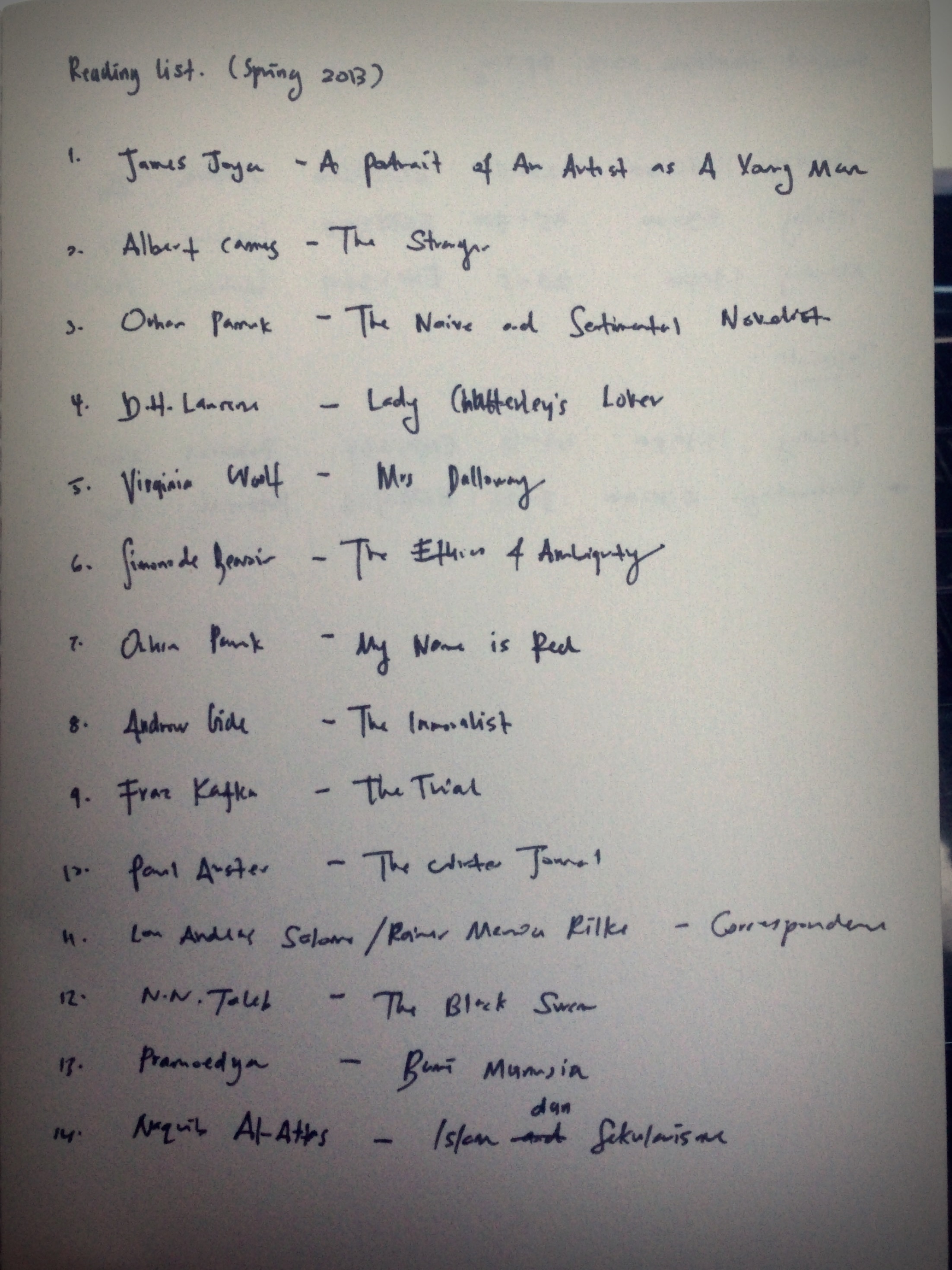
I finished The Immoralist, finally, and am puzzled at what sort of actions that he did that was so immoral. (That is, compared to the current generation). He likes little strong boys, and finds delight in the wild. Resisting temptation to fall into individualism, that is to reject what is normal (deemed by society/religion), and to pursue one’s own desires. It is a wonderful book nevertheless, but I quite disagree with Menalque’s statement “the worst people are people with principles”. What if our principle is to not to abide by any principle? And what shall guide one’s course of direction in life? Intuition, pleasure, impulsion? Are we not better off grounded, to find some permanence, somewhere?

I guess in the 1920s everyone in the West still held on to some moral values, as opposed to today’s generation. The Great Gatsby is a fine example of that. That was why this book (The Immoralist) was famous back then. 

Then there was the question of Metaphysics. Man and Nature. The removal of the religious aspect from science. Truth (of nature) consists of things that can be seen by the eye, evidenced, experimented, quantified, measured, replicated. Concrete. Such it was that we only learn things without knowing the meaning behind it all. Is the pursuit of science itself the reason to study it? To what end, then? It is said that the ancient people studied the stars in order to understand their own nature, their own existence. What, who governed them? There you have all the Greek mythologies. Then came Aristotle with all his clean logic and they cast out the gods in order to understand the natural world as it is. 

When I enrolled into the Human Geography class, (and later dropped it), the lecturer said that the relationship between Man and Nature can be viewed either as science, an enemy, holistically, or by their usefulness. It was Descartes who introduced this kind of thinking (science), separation, making Man more superior than nature (I think, therefore I am). Hobbes saw nature as an uncivilised, harsh, untamed thing, and aligns nature with the female (must be possessed, taken control of). John Locke perceived nature as a resource, where man can rightfully claim nature and use it to his will. Finally, holistically, where there is exists no separation between two entities, one integrates,feels,  ‘understands’ each other, as advocated by the religions.

It is important to re-instill purpose to science. Are we to advocate ourselves, to put ourselves at the center of everything, or are we to have some sort of ground, to understand and use science?

This morning waking up I looked around A’s desk and found Yasmin Mogahed’s book. I fell upon the verse that in the end, everything else desists and only Allah endures. 

narration

It is as if she had gained a voice, in the back of her head. She would at something, be it a remark, a gesture, and turn it all into a metaphor. The car cannot reach 85, his capacity is only 50. Meaning, I am not capable yet. A parallel narration that treads over on and on that one seems to chuckle at its absurdity. Indeed, what has happened? Life resumes, and again, you are reminded by people’s goodness left and right. Lenggang dan Gong, kata Marham, whom I doubt I shall meet again. He hasn’t texted me yet.

I was reading the Quran in front of the library (such is the habit now, on the bus, on the pavement, waiting for an arrival, any such time would do), when he sat puppy eyed and said hi to me. I am straight from Indonesia, and I just arrived this morning, and I don’t know my way around here. I stopped and say, what can I help you with. We talked and talked until he found someone he accidentally found Mika, someone he asked help of the day before on Facebook.

“It is a strange moment for me, all this occurrences. I thank you”.

“When it read the Quran it goes into your heart and pours out of being, your eyes your ears. Melimpah. You are soaking yourself with the words of Allah”

Dr. Salleh says that he felt every fiber, every atom of his being, utter the “Iyyaka Na’budu” (To You Alone We Worship), when he stood in prostration in front of the Kaabah.

I find these small correlations wonderful, how things happen in succession, one after another. Like a mesh, one begins to connect from A to B to C and to all alphabets, put everything into its place, and find significance in them. Look how form and content work together to create meaning, says my English Lit teacher.

transference

She was the darling of the night, all wide eyed and excited, talking to those who would speak to her.

“Really? You made this?”

Wonderful. Very nice”

“Awwww. Thank you”, I said, in the spirit of her own.

***

I fumbled through her playlist and found Pete Doherty’s Last of the English Roses. This was our song;  we would sing this into the end of night, not understanding a word of it, but it was beautiful, the night was beautiful, the scenery was beautiful. It all made perfect sense.

It is nice to instantly reconnect after four, long, absent years. The space between them evaporates and become the fuel of conversations, from stargazing to bush walking to mountain climbing to  photography to politics to literature to fresh grass to the wondrous people surrounding our lives.

***

“Tell me when I return”. A promise is then made, and from there she would shoot in different courses of directions. The possibilities. In the end, when everyone is asked, all opinions are laid, all arguments are made, it is hers alone that matters. “The heart of the matter, is that I…. simply cannot choose”. So much complications, this matter of the heart. She wanted to do justice to all, to “treat everyone right“, but like Plath (again?), she will be at the center of atrocity.

The woman who sat next to her asked her if she was married. She says no, no, I am in a dilemma. In a year or two, or perhaps never at all.

***

The girls said that her father says “It is hard to take care of women. So, we should marry them off as soon as we can”.

Such a simplistic argument. Are we to cook, to clean, to care for children ? Is there no other role for a woman, except to become a burden until we are carried off to someone else. Is the pinnacle achievement for us is to enter motherhood?

She is only a girl of twelve. The mother married at eighteen. What would become of her, in five, six years time?

The sound of the twenty-odd children in the room roaring and shouting and screaming and crying in the room that we left echoed behind us.

there will be time

So I decided to spend the remaining weeks at home. There will time, time to play, time to read, time to sleep, time for the nightly cycle to the mosque, time for shopping and time to write. One contemplates home but see it as an impossibility. To bargain time (and money) is not wise. If one needs to focus on the self, one needs to remove oneself from the family. There will time to visit Auburn and the promise of Nasi Ayam. There will be time for chocolate cake and chocolate chip biscuits. There will be time for festivities, for late night rendezvous, firing up the charcoal and burning satay beneath the starry night.  There will time for goodbyes and encounters and hellos. There will be time for annoyances that must be suppressed.

I have made a reading list, and know not whether I shall follow them through. I must go through at least half of them, anyway, for it is a requirement for the semester. Add this to our spiritual nourishment in Ramadan, I try to finish the Quran in the allocated time. This is a new feat for me, so I t tell it to people such that I shall be encouraged to finish. In the beginning of Ramadan, I met Dr Salleh, a professor of Theology, out of pure chance, and he says (among other things)  that finishing is more understanding at this point, understanding takes more than a lifetime, so one must set one’s priorities straight.

Like Hanna Madeline, I am currently at the centre of a plot.  But I shall not choose, I refuse to choose. To ruminate over this takes the life out of me, so I shall leave, leave things as they are.DSC_1785

bright yet vague

“Bright yet vague. She is perhaps twenty-two. She is shabby. She crosses the road and looks at the daffodils and the red tulips in the florist’s window. She hesitates, and makes off in the direction of Temple Bar. She walks fast, and yet anything distracts her. Now she seems to see, and now to notice nothing.”

-Jacob’s Room, Virginia Woolf

As she walked through the narrow streets of Osaka, seeing the workers at her side unloading the cargo, stacking one boxes against another, to be carried off to places she will never know off. Kobe, perhaps? Rainy gloomy western Kobe. Murakami’s Kobe.

It takes me ten minutes to the station. What delight do I find myself in?

I talk to the lockerman on the station and he tells me, in signs, that my bag is too small and I should proceed to the locker room on his left. I heard hyaku hyaku. I have mastered the numbers. I speak to the old men in the bicycle shop, renting a pink bicycle to go around Arashiyama. I speak of directions. One passes through the plot of grass in the middle of the hundred of ancient houses. I tell the British couple the direction to the bamboo path. I walk up to some neglected temple only to be shun away for not wanting to pay five hundred yen to see the view of Kyoto from afar. I struck the bell five times and then resume downhill, speeding down my bike, delighted by the sound of the scenic train choo choo-ing, took pictures of enthusiastic schoolboys and schoolgirls on a boat. The rail crossing. I stop at the bridge when my map of the place was blown off by the wind. The lady in the kimono in front of the entrance of some fancy restaurant smiled at me. I cycled through stones statues and arrive at another temple. I didn’t go inside. One gets tired of temples eventually. I tried to find some udon but the old lady said she only sells soba. So I cycled  to a nearby bamboo shop and she offered me green tea. Oishii, I said.

capacity

if the vessel is broken to begin with, how can one love? it oozes, it overspills, it falls between the cracks, it is imperfect. it is fouled, for not only do we mistake lust, for love, the mundane, for the divine, but we add in all kinds of illusions into it. eternity, affinity, dependency. what was once reserved for the sacred now becomes profane. 

“i do not know what would i do without you,”

“it is only you that i can confide into,”

“in the end, i return to you.”

“i want to love you forever.”

alas, you can never contain me to begin with.

love

I am in love, but at the same time I want to unlove. It overpowers me. So I seek ways to break off with another when I know my incapacity to do so, and so I severe myself in ways I can but always come, in time,  unfurling before him, baring all that is within me.

I am in love, but at the same time I want to love another. I want to seek the possibilities in the unknown, the mysterious, the unattainable, even in the mundane; it is the over-spilling of love that I want to extend towards others.